Love this? Save it for later!
Share the inspiration with your friends
The neighborhood block party was in six hours and I’d completely forgotten I was supposed to bring the bread. Everyone else would be showing up with those gorgeous, bakery-style loaves—you know, the ones with the fancy scoring and the perfect ear. I had a jar of sourdough discard staring at me from the back of the fridge, a bag of flour, and honestly, not a lot of hope. I’d been meaning to try a no-knead focaccia for months, but life kept getting in the way. Thursday afternoon at 2 PM, with a pile of laundry and a hungry family, I finally had no choice but to give it a shot.
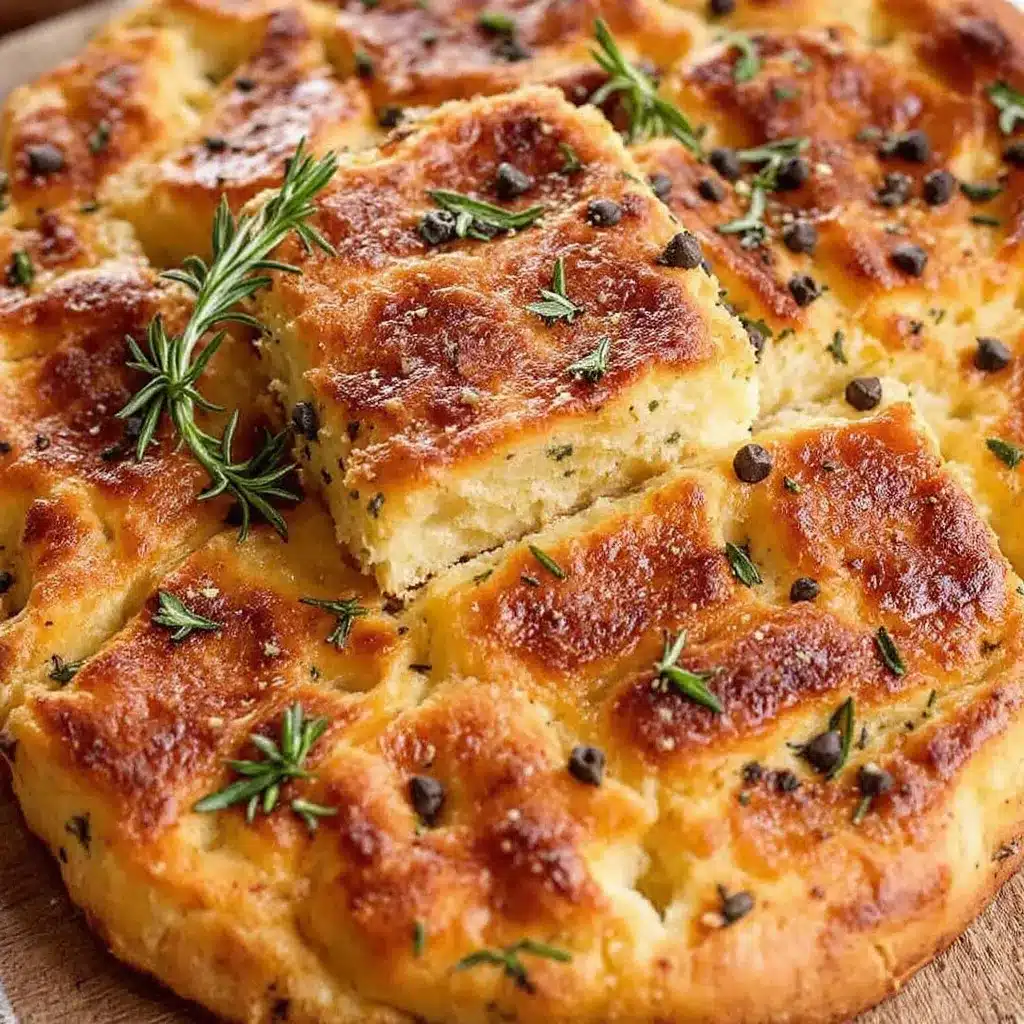
I practically dumped the ingredients into a bowl—no folding, no kneading, just a quick stir and a prayer. I let it sit on the counter while I folded socks and answered emails, and by the time I remembered it, the dough had turned into this bubbly, alive thing. I dimpled it with my fingers, drizzled it with olive oil, and threw some rosemary on top because that’s what I had. It came out of the oven looking like something you’d pay fifteen bucks for at a fancy café. I mean, the golden crust, the crispy edges, the soft, airy middle—it was ridiculous.
I carried it to the party wrapped in a kitchen towel, feeling a little sheepish. My neighbor Karen had brought a sourdough boule she’d been working on for three days. I won’t lie, I was nervous. But when I cut into that focaccia, the smell of rosemary and olive oil just floated through the air, and people started gathering. It was gone in twenty minutes. Someone asked for the recipe, and I had to admit it took about five minutes of actual hands-on work. Maybe you’ve been there—showing up with the simplest thing and watching it steal the show. That’s why this recipe has become my secret weapon. It’s the one I keep making, not because it’s fancy, but because it’s honest. It works every single time.
Why You’ll Love This Recipe
This easy no-knead sourdough discard focaccia with rosemary is the kind of recipe that makes you look like a hero with almost no effort. I’ve tested it a dozen times, tweaking the hydration and the rise times, and I can honestly say this version is foolproof. It’s the bread I bring to every gathering now, and it never fails to get those happy little murmurs from people.
- Quick & Easy: The hands-on time is about ten minutes. Seriously. The rest is just waiting for the magic to happen.
- Simple Ingredients: You probably have everything already—flour, water, olive oil, salt, rosemary, and that sourdough discard you’ve been meaning to use.
- Perfect for Sharing: Whether it’s a potluck, a dinner party, or just a Tuesday night, this focaccia fits right in.
- Crowd-Pleaser: I’ve served it to kids, food snobs, and gluten-free skeptics (the skeptics didn’t last long). Everyone loves it.
- Unbelievably Delicious: That crisp, golden crust and the soft, chewy interior with the fragrant rosemary and fruity olive oil? It’s next-level comfort food.
What makes this recipe different from the rest is the technique. Using sourdough discard instead of yeast gives the bread a subtle tang and a better texture, but without the long fermentation times. It’s a shortcut that actually improves the result. And the no-knead method means you don’t need a stand mixer or any fancy equipment—just a bowl and a spoon. This isn’t just another focaccia recipe. It’s the one you’ll come back to again and again, the one that makes you close your eyes after the first bite. It’s comfort food reimagined—simpler, faster, but with the same soul-soothing satisfaction. Perfect for impressing guests without stress, or turning a simple meal into something memorable.
What Ingredients You Will Need
This recipe uses simple, pantry-friendly ingredients to deliver big flavor without any fuss. Most of these are things you likely already have in your kitchen, which is exactly how I like to cook.
- All-purpose flour, 3 cups (375 g) – I prefer King Arthur Flour for consistent results, but any brand works. Bread flour also works for a chewier texture.
- Sourdough discard, 1 cup (240 g), unfed and at room temperature – This is the star. Use it straight from the fridge if you’re in a hurry, but room temp gives a better rise.
- Warm water, 1 cup (240 ml), about 100°F – Not too hot! You want it warm to the touch, like bath water.
- Olive oil, 1/4 cup (60 ml), plus more for drizzling – Use a good-quality extra virgin olive oil for the best flavor. I like California Olive Ranch.
- Salt, 1 1/2 teaspoons (9 g) – Fine sea salt or kosher salt. Avoid iodized salt if you can.
- Fresh rosemary, 2 tablespoons, finely chopped – Dried rosemary works in a pinch, but fresh is really special here.
- Flaky sea salt, for topping (optional but recommended) – Maldon is my go-to. It adds that perfect crunch.
Ingredient Tips: If your sourdough discard is really thick, you might need to add an extra tablespoon of water. The dough should be sticky and shaggy, not stiff. For a dairy-free version, this recipe is already dairy-free! If you want to add some extra flavor, try infusing the olive oil with garlic or herbs before drizzling. I’ve also made this with whole wheat flour (substitute up to half the all-purpose flour), and it turns out heartier and nuttier. Just note that it will be a little denser.
Equipment Needed
You don’t need a lot of fancy tools for this recipe, which is part of the beauty. Here’s what you’ll need:
- Large mixing bowl – Any bowl works, but I prefer a wide one for easy stirring. My favorite is a simple ceramic bowl I picked up at a thrift store.
- Wooden spoon or spatula – For stirring the dough. A silicone spatula is great for scraping down the sides.
- 9×13-inch baking pan – A metal or glass pan works. I’ve used both, and metal gives a slightly crispier bottom crust.
- Plastic wrap or a clean kitchen towel – To cover the dough while it rises. I use a reusable beeswax wrap now, but a damp towel works fine.
- Measuring cups and spoons – For accuracy. I recommend a kitchen scale for the flour, but cups work too.
- Small bowl – For mixing the rosemary and oil topping.
- Pastry brush – For brushing the olive oil mixture. You can also just drizzle it on.
Budget-friendly options: Don’t have a 9×13 pan? Use a cast-iron skillet or a round cake pan. The shape will be different, but the taste is the same. No pastry brush? Just use your fingers to spread the oil—it’s actually more rustic that way!
Preparation Method
- Mix the dough (5 minutes): In your large mixing bowl, combine the all-purpose flour and salt. Add the sourdough discard and warm water. Stir with your wooden spoon or spatula until a shaggy, sticky dough forms. It will look rough and not at all like a traditional bread dough—that’s exactly right. Don’t overmix. Scrape down the sides of the bowl, cover with plastic wrap or a towel, and let it rest for 30 minutes. This short rest allows the flour to hydrate and starts the gluten development.
- First rise (2-3 hours): After the rest, you’ll see the dough has relaxed and become more cohesive. Drizzle 1 tablespoon of olive oil over the top, then fold the dough over itself a few times—just grab an edge, stretch it up, and fold it over the center. Do this 4-5 times around the bowl. It’s not kneading, just a gentle fold. Cover again and let it rise at room temperature for 2-3 hours, or until it has doubled in size and looks bubbly and airy. The timing depends on how active your discard is and the temperature of your kitchen. On a warm day, it might be ready in 2 hours. On a cooler day, it could take 4. Look for the visual cues: it should be puffy and full of bubbles.
- Prepare the pan (5 minutes): While the dough is rising, pour 2 tablespoons of olive oil into your 9×13-inch baking pan. Use your fingers or a pastry brush to coat the bottom and sides evenly. This is crucial for that crispy, golden crust. Set the pan aside.
- Second rise (1-2 hours): When the dough has doubled, gently scrape it out of the bowl and into the oiled pan. Don’t punch it down—be gentle. Let it sit for 10 minutes to relax, then use your fingertips to gently stretch and press the dough to fit the pan. It might not reach the edges at first; that’s okay. Cover the pan with plastic wrap or a towel and let it rise again for 1-2 hours, until it’s puffy and fills the pan. The dough should feel soft and pillowy, like a marshmallow.
- Preheat the oven (20 minutes before baking): About 20 minutes before the second rise is done, preheat your oven to 425°F (220°C). Place a rack in the middle position. If you have a baking stone or steel, put it in the oven to preheat—it helps create a crispier bottom.
- Dimple and top (5 minutes): Once the dough has risen, drizzle 1 tablespoon of olive oil over the top. Now for the fun part: use your fingertips to press dimples all over the surface of the dough. Press all the way down to the bottom of the pan. Don’t be shy—the dimples are what give focaccia its signature texture and hold the oil and toppings. Sprinkle the chopped fresh rosemary evenly over the top, and add a generous pinch of flaky sea salt. If you want extra flavor, you can also press in some halved cherry tomatoes or thin slices of garlic at this point.
- Bake (20-25 minutes): Place the pan in the preheated oven and bake for 20-25 minutes, until the top is deep golden brown and the edges are crispy and pulling away from the sides of the pan. The bottom should be golden and sound hollow when tapped. If your oven runs hot, check at 18 minutes. The smell in your kitchen right now is absolutely intoxicating—rosemary and olive oil and toasted bread.
- Cool and serve (10 minutes): Remove the pan from the oven and let the focaccia cool in the pan for 5 minutes. Then transfer it to a wire rack to cool for another 5-10 minutes. This step is important—if you cut it too soon, it will be gummy inside. Slice it into squares or rectangles and serve warm or at room temperature. I like to drizzle a little more olive oil on top just before serving, because why not?
Troubleshooting tip: If your dough seems too sticky and doesn’t hold its shape, don’t panic. That’s normal for high-hydration doughs. Just use a little more oil on your hands and the pan. If it’s too dry and stiff, add a tablespoon of warm water next time. The dough should be soft and slightly tacky, not dry.
Cooking Tips & Techniques
I’ve made this focaccia more times than I can count, and I’ve learned a few things the hard way. Let me save you some trouble.
Don’t skip the rest after mixing. That first 30-minute rest, called an autolyse, is where the gluten starts developing without any work from you. I once skipped it because I was in a hurry, and the dough never rose properly. It was flat and dense—still edible, but not the fluffy focaccia I wanted. Patience pays off here.
Use your discard straight from the fridge if you need to. I’ve done it many times. Just let the dough rise a little longer, maybe an extra hour, to compensate for the cold starter. The flavor actually develops more deeply with cold discard.
Watch the oven temperature. Every oven is different. My first few batches came out pale and soft because my oven runs cool. I bought a cheap oven thermometer and discovered it was off by 25 degrees. Now I preheat to 450°F and let it sit for an extra 10 minutes before baking. The high heat is what gives you that crackling crust.
Don’t overdo the rosemary. I love rosemary, but too much can overpower the delicate flavor of the bread. Two tablespoons of fresh, finely chopped rosemary is the sweet spot. If you’re using dried, use half as much—it’s more concentrated.
Multitasking strategy: While the dough is doing its first rise, I prep my other dishes or clean the kitchen. During the second rise, I set the table or make a salad. It makes the whole process feel effortless.
For a crispier bottom crust, bake the focaccia directly on a preheated baking stone or steel. If you don’t have one, place a baking sheet upside down on the rack below the focaccia pan—it helps distribute the heat.
Variations & Adaptations
This easy no-knead sourdough discard focaccia with rosemary is a fantastic base for all kinds of creative twists. Here are a few of my favorites:
- Garlic and Herb Focaccia: Add 3-4 cloves of minced garlic to the olive oil before drizzling it on top. Press thin slices of garlic into the dimples along with the rosemary. The garlic roasts and becomes sweet and mellow—it’s incredible.
- Tomato and Olive Focaccia: After dimpling, press halved cherry tomatoes and pitted Kalamata olives into the dough. The tomatoes burst in the oven, creating little pockets of jammy sweetness. I made this for a summer picnic, and it was gone before the sandwiches.
- Cheesy Focaccia: Sprinkle 1/2 cup of grated Parmesan or crumbled feta over the top before baking. The cheese gets crispy and golden in the oven. My kids go crazy for this version—it’s like a cheese bread and focaccia had a baby.
- Gluten-Free Option: Substitute a 1:1 gluten-free flour blend that contains xanthan gum. The texture will be a bit denser and more cake-like, but it’s still delicious. I’ve tested this with Bob’s Red Mill 1:1 Baking Flour, and it works well. Add an extra tablespoon of water if the dough seems dry.
- Sweet Focaccia: For a dessert version, skip the rosemary and salt. Instead, dimple the dough and drizzle with honey or maple syrup, then sprinkle with cinnamon and a little brown sugar. Bake as directed and serve warm with a dusting of powdered sugar. It’s like a giant, shareable pastry.
I tried a version with caramelized onions and thyme last fall, and it was so good I made it three weeks in a row. The sweetness of the onions paired with the tangy sourdough was a match made in heaven. Don’t be afraid to experiment—focaccia is forgiving and loves company.
Serving & Storage Suggestions
This focaccia is best served warm, fresh from the oven, when the crust is still crispy and the inside is pillowy soft. But honestly, it’s fantastic at room temperature too. I often make it a few hours ahead for parties, and it’s always a hit.
Serving ideas: Slice it into squares and serve alongside a bowl of olive oil and balsamic vinegar for dipping. It’s perfect with soups, stews, or salads. I love it with a big bowl of tomato basil soup or a hearty minestrone. For a light meal, serve it with a simple arugula salad dressed with lemon and Parmesan. It also makes amazing sandwich bread—slice it horizontally and fill it with roasted vegetables, fresh mozzarella, and pesto.
Storage: Store leftover focaccia in an airtight container at room temperature for up to 2 days. Don’t refrigerate it—the fridge will dry it out and make it stale. If you need to keep it longer, freeze it. Wrap individual slices tightly in plastic wrap, then place them in a freezer bag. They’ll keep for up to 3 months.
Reheating: To bring back that fresh-baked texture, reheat the focaccia in a 350°F oven for 5-7 minutes. You can also pop it in a toaster oven or air fryer at 350°F for 3-4 minutes. Avoid the microwave—it will make the bread soggy and rubbery. I learned that the hard way when I was hungry and impatient.
Flavor development: Interestingly, the flavor of this focaccia actually improves after a day. The tang from the sourdough becomes more pronounced, and the rosemary infuses the bread more deeply. So if you can resist eating it all immediately, the leftovers are a treat.
Nutritional Information & Benefits
Here’s the approximate nutritional breakdown for one serving (1/8 of the recipe):
| Nutrient | Amount per Serving |
|---|---|
| Calories | 220 |
| Total Fat | 9 g |
| Saturated Fat | 1.5 g |
| Carbohydrates | 30 g |
| Fiber | 1.5 g |
| Protein | 5 g |
| Sodium | 350 mg |
Health benefits: Sourdough is easier to digest than conventional bread because the fermentation process breaks down some of the gluten and phytic acid. This means your body can absorb more of the nutrients from the flour. The olive oil provides healthy monounsaturated fats, and rosemary is packed with antioxidants. This recipe is naturally dairy-free and can be made vegan easily. It’s also lower in sugar than most store-bought breads.
Dietary considerations: This focaccia contains gluten (unless you use the gluten-free option). It’s suitable for vegetarian and vegan diets. If you’re watching your sodium, you can reduce or omit the flaky sea salt on top. I personally love that this bread feels indulgent but is made from whole, simple ingredients. It’s the kind of food that nourishes you without making you feel heavy.
Conclusion
This easy no-knead sourdough discard focaccia with rosemary is more than just a recipe—it’s a revelation. It proves that you don’t need hours of kneading, a sourdough starter that’s been fed for generations, or a culinary degree to make incredible bread. All you need is a little patience, a few simple ingredients, and the willingness to let the dough do the work.
I love this recipe because it’s forgiving. It doesn’t care if you forgot to feed your starter. It doesn’t mind if your kitchen is a little chilly. It just wants to be mixed, left alone, and baked into something beautiful. Every time I make it, I’m reminded that the best things in life are often the simplest. I hope you’ll give it a try and make it your own—add your favorite toppings, experiment with different herbs, or just enjoy it plain with a drizzle of good olive oil.
I’d love to hear how yours turns out! Did you try a variation? Did your family devour it in minutes? Leave a comment below and share your focaccia adventures. And if you loved this recipe, don’t forget to pin it for later and share it with a friend who needs a little bread magic in their life. Happy baking, friend!
Frequently Asked Questions
Can I use active sourdough starter instead of discard?
Absolutely! If you use active, bubbly starter, the focaccia will rise faster and have a milder tang. Just reduce the rise time by about an hour, and keep an eye on the dough. It should double in size before baking.
Why is my focaccia dense and not airy?
This usually happens if the dough didn’t rise long enough or if the water was too hot and killed the natural yeast in the discard. Make sure your water is warm, not hot, and give the dough enough time to double. Also, check that your sourdough discard is reasonably fresh—if it’s been sitting in the fridge for months, it might be too weak to leaven the bread.
Can I make this focaccia gluten-free?
Yes! Use a 1:1 gluten-free flour blend that contains xanthan gum. The texture will be a bit more cake-like and less chewy, but it’s still delicious. I’ve had good results with Bob’s Red Mill 1:1 Baking Flour. Add an extra tablespoon of water if the dough seems dry, and let it rise for the full time.
How do I store leftover focaccia?
Store it in an airtight container at room temperature for up to 2 days. For longer storage, wrap individual slices in plastic wrap and freeze for up to 3 months. Reheat in a 350°F oven for 5-7 minutes to restore the crispy crust. Avoid refrigerating, as it will dry out the bread.
Can I use dried rosemary instead of fresh?
Yes, but use half the amount—about 1 tablespoon of dried rosemary. Dried herbs are more concentrated. I recommend crushing the dried rosemary between your fingers before sprinkling it on to release the oils. Fresh rosemary gives a brighter, more fragrant flavor, but dried works in a pinch.
Pin This Recipe!
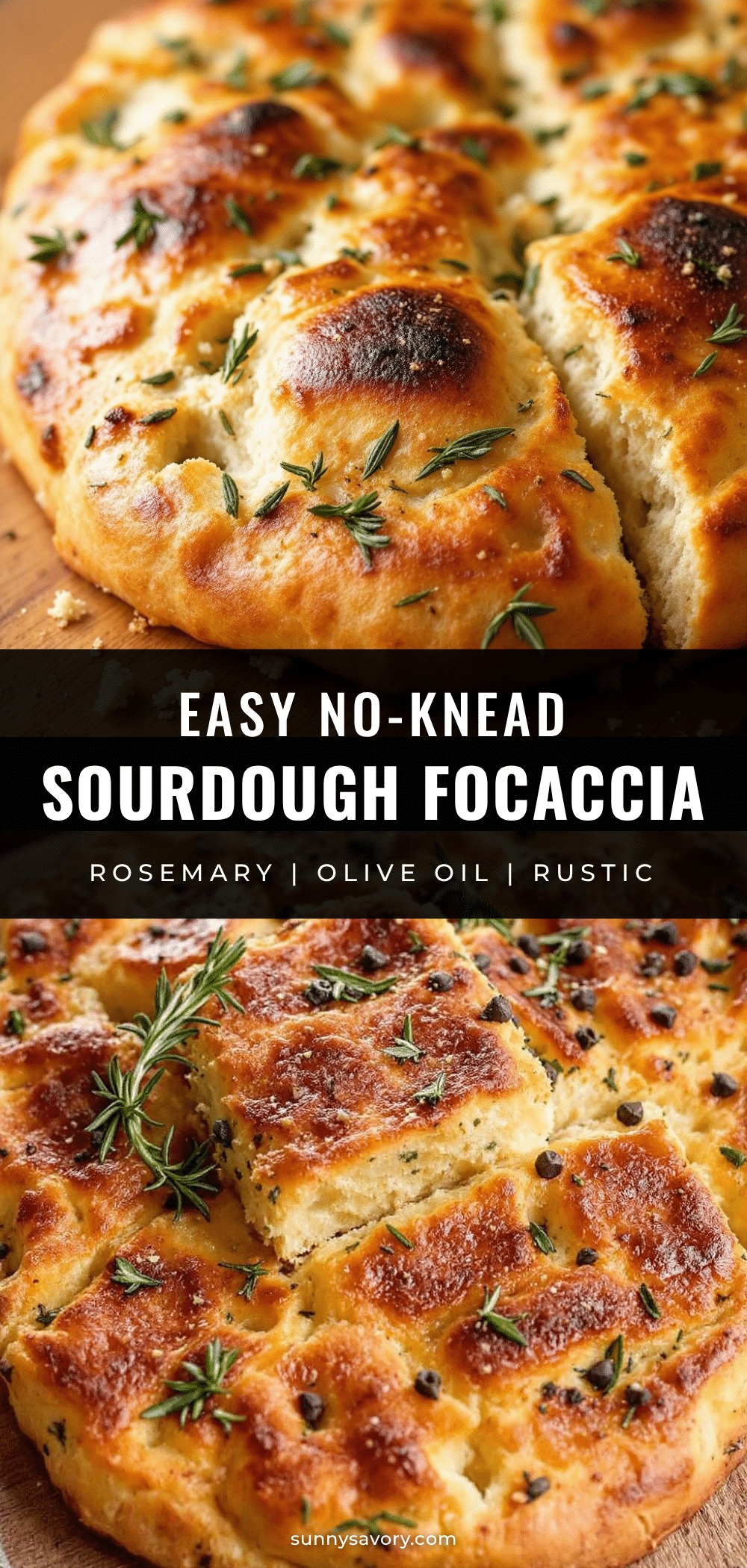
Best Easy No-Knead Sourdough Discard Focaccia with Rosemary

This easy no-knead sourdough discard focaccia with rosemary is a foolproof recipe that requires minimal hands-on time and delivers a golden, crispy crust with a soft, airy interior. Perfect for impressing guests or turning a simple meal into something memorable.
- Prep Time: 10 minutes
- Cook Time: 20-25 minutes
- Total Time: 3 hours 35 minutes to 5 hours 35 minutes
- Yield: 8 servings 1x
- Category: Bread
- Cuisine: Italian
Ingredients
- 3 cups (375 g) all-purpose flour
- 1 cup (240 g) sourdough discard, unfed and at room temperature
- 1 cup (240 ml) warm water (about 100°F)
- 1/4 cup (60 ml) olive oil, plus more for drizzling
- 1 1/2 teaspoons (9 g) salt
- 2 tablespoons fresh rosemary, finely chopped
- Flaky sea salt for topping (optional)
Instructions
- Mix the dough (5 minutes): In a large mixing bowl, combine the all-purpose flour and salt. Add the sourdough discard and warm water. Stir with a wooden spoon or spatula until a shaggy, sticky dough forms. Scrape down the sides, cover with plastic wrap or a towel, and let rest for 30 minutes.
- First rise (2-3 hours): After the rest, drizzle 1 tablespoon of olive oil over the dough. Fold the dough over itself 4-5 times around the bowl. Cover and let rise at room temperature for 2-3 hours, until doubled in size and bubbly.
- Prepare the pan (5 minutes): While the dough rises, pour 2 tablespoons of olive oil into a 9×13-inch baking pan. Coat the bottom and sides evenly.
- Second rise (1-2 hours): Gently scrape the dough into the oiled pan. Let it sit for 10 minutes, then use your fingertips to gently stretch and press the dough to fit the pan. Cover and let rise for 1-2 hours, until puffy and filling the pan.
- Preheat the oven (20 minutes before baking): Preheat oven to 425°F (220°C) with a rack in the middle position.
- Dimple and top (5 minutes): Drizzle 1 tablespoon of olive oil over the dough. Use your fingertips to press dimples all over the surface. Sprinkle with chopped rosemary and flaky sea salt.
- Bake (20-25 minutes): Bake for 20-25 minutes until deep golden brown and edges are crispy. The bottom should be golden and sound hollow when tapped.
- Cool and serve (10 minutes): Let cool in the pan for 5 minutes, then transfer to a wire rack for 5-10 minutes. Slice and serve warm or at room temperature.
Notes
For a crispier bottom crust, bake on a preheated baking stone or steel. If dough seems too sticky, use more oil on your hands and pan. If too dry, add a tablespoon of warm water. The flavor improves after a day.
Nutrition
- Serving Size: 1/8 of recipe
- Calories: 220
- Sodium: 350
- Fat: 9
- Saturated Fat: 1.5
- Carbohydrates: 30
- Fiber: 1.5
- Protein: 5
Keywords: sourdough discard, focaccia, no-knead, rosemary, easy bread, sourdough recipe